Iboga is taken by mouth, as root bark, in a night-long ceremony served by initiated Bwiti healers — after an interview, a health questionnaire and a recent ECG.
Here is what that means in practice, where the real risks are, how the law stands, and why iboga and ibogaine are not the same thing.
Iboga is taken by mouth, as the root bark of the Tabernanthe iboga shrub, during a single night-long ceremony held in the Bwiti tradition. The amount is decided and served by initiated healers, never by the person taking it. Before that night: an interview, a health questionnaire and a recent electrocardiogram. Through the night: constant supervision. After it: psychotherapy and integration.
Most people who search for how to take iboga are really asking about a dose. That is the wrong question, and it is why this page exists. Iboga is not something you take on your own terms — it is something you are taken through. What decides how the night goes is who holds it, what screening happened before it, and what support is waiting the morning after.
We do not sell or ship iboga. It is served on site only, in ceremony, under supervision — and only to people who have been through the interview and the health screening.
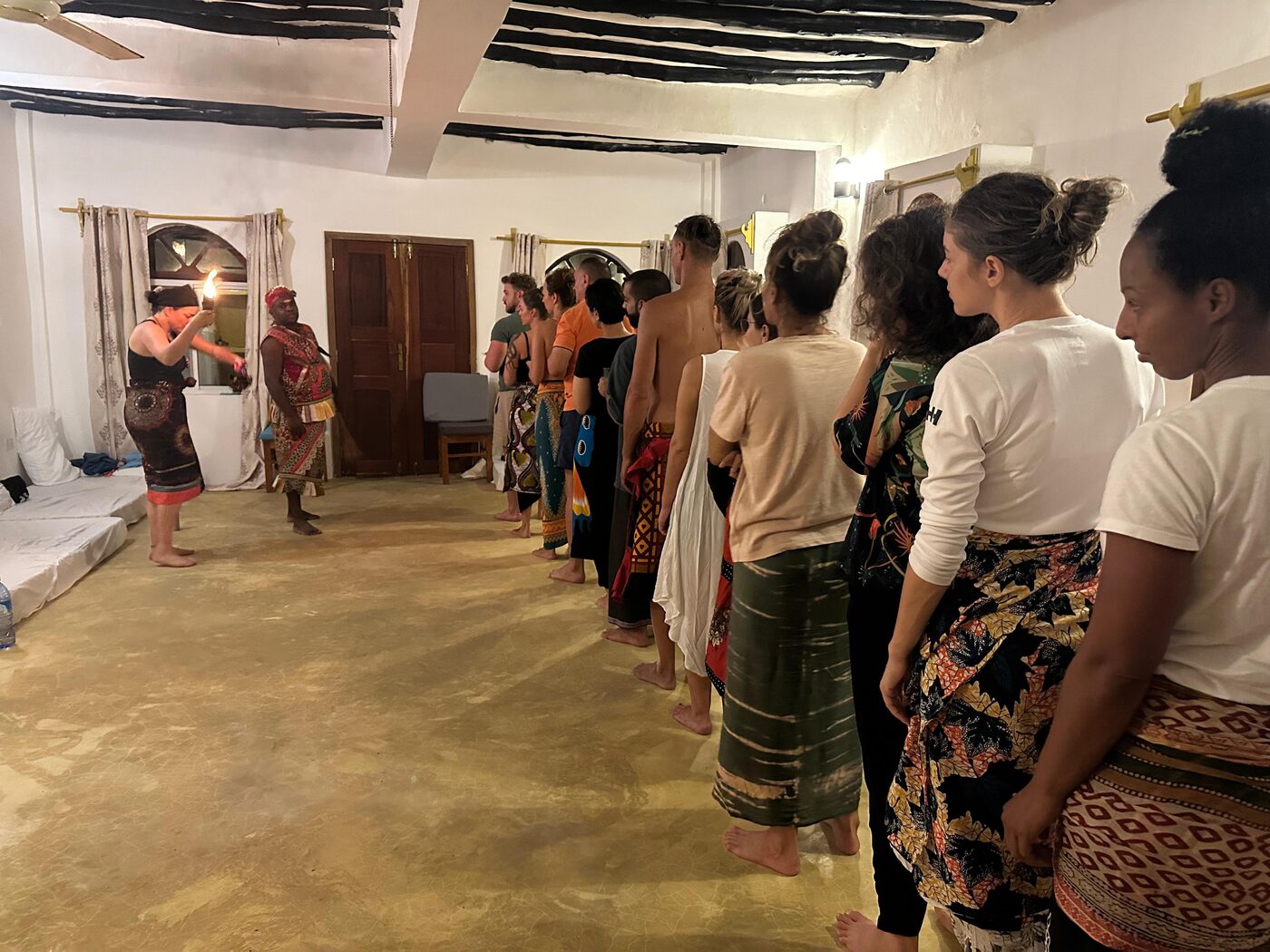
This is the part most articles about iboga leave out. Ask the healers who serve it and not one of them will tell you the plant does the healing. The plant carries you as far as the threshold. What meets you there is the ceremony — the Bwiti tradition, the songs and the drum, the fire, the rituals handed down through generations, the presence of the ancestors and of people who have crossed that night many times before you.
That is also what turns the crossing into a safe passage rather than a gamble. Iboga on its own is a substance. Held inside Bwiti, by initiated healers, with reverence, it becomes a doorway. How the whole container works →
From the first message to the flight home, the process has four stages. None can be skipped — and the first one can end it.
Iboga carries real cardiac risk. That single sentence should shape every decision you make about it, here or anywhere else. A responsible process requires a recent ECG, a health questionnaire, screening for contraindications, and someone awake and watching for the whole ceremony.
Certain medications and conditions can be dangerous with iboga — antidepressants (SSRIs), sleeping pills, and some heart or liver conditions among them. Any change to medication is made only with your own doctor, never on a facilitator's word. And there is no version of this that works alone, at home, with something bought online: outside a screened, supervised ceremony, the risk is not one you can manage yourself.
Medication is only half of it. Iboga also interacts with whatever else is still in your system — alcohol, cannabis, stimulants, other recreational substances. For the night to be both safe and therapeutic, your body has to be in its own natural state when the ceremony opens, which means at least 7 days clear beforehand — time to clear and time to recover. For some people that is the hard part, and we understand it fully. It is a commitment we make together: the safety of the night rests on it, and so does how much you can take home from it.
A retreat that takes everyone, without an interview and without screening, is telling you something about how it will handle the night. Eight criteria for choosing a safe retreat →
Iboga's legal status differs from one country to another — restricted in some, unregulated in others. There is no single answer that covers everyone reading this, so the honest advice is simple: check the law where you live before you travel, and never carry the plant across a border.
Our retreat takes place in Zanzibar, Tanzania, within the Bwiti tradition. We do not sell or ship iboga, and the ceremony happens on site only, under supervision. What is offered here is an experience — ceremony, psychotherapy and integration — not a medical treatment, and it does not replace medical or psychological care.
Separately from that, ibogaine is being studied in clinical settings under cardiac screening and medical supervision. We keep the two apart, and we would rather you read the studies than take our word for anything. What the research actually says →
The two words get used as if they were interchangeable. They are not, and the difference matters to anyone trying to understand what they would actually be taking.
The whole root bark of the Tabernanthe iboga shrub, as it has been used for centuries in the Bwiti tradition of Gabon. It holds ibogaine alongside other alkaloids, and it is served in ceremony. This is what our retreat works with.
The most active alkaloid on its own, isolated from the plant. This is the form used in clinics and in clinical research, given under cardiac monitoring. A pharmaceutical extract, not a ceremony.
Both require cardiac screening. What separates them is the frame: one is a tradition with a night, a song and a lineage around it; the other is a molecule in a medical protocol. Neither is a shortcut. More about the plant and where it comes from →
No — and we would say this even if we had nothing to offer you. Without an ECG, without screening for contraindications, and without someone supervising the whole night, the cardiac risk is not one you can manage on your own. We do not sell or ship the plant, and we would treat anyone who does with suspicion.
SSRIs, sleeping pills and several other medications can be dangerous in combination with iboga, so this is discussed openly during the interview. Any tapering or change is made by your own doctor, on their timeline — never on ours.
At least 7 days with no alcohol, cannabis, stimulants or other recreational substances. Iboga interacts with whatever it finds in your system, and your body needs that stretch to come back to its own baseline — that is what keeps the night safe and lets it do what it can do. This is not a moral test and nobody here is judging: if seven days sound hard to hold, say so in the interview and we work out together whether now is the right time.
The first 4–8 hours are the most intense — a visionary, dreamlike state, often with vivid imagery and memories from your own life. A longer introspective phase follows, and in the days after you may feel sensitive and need rest. That is why the ceremony sits inside a 7-night retreat and not inside a weekend.
By interview, not by payment. Groups are capped at 12 people, with 2 initiated Bwiti healers, 4 assistants and a translator alongside them. If the timing or your health says no, a responsible facilitator tells you so rather than taking your booking. Practical questions about the retreat itself →
Dates, price, what is included, who guides you and how to apply for an interview — all the details of the next edition are on the main page.
The 1–8 November 2026 retreat →