This is an iboga retreat held in Zanzibar, Tanzania — not in Europe, where iboga has no legal place for this kind of work.
It is guided by a small team based in Europe, but the ceremony itself stays where the tradition it comes from is still alive.
Iboga is not a plant that grew up around retreat centres. It comes from the equatorial forests of Central Africa, where the Bwiti tradition of Gabon has held it — for initiation, for healing, for reconnection — for centuries. Any retreat that uses it owes something to that origin, whether it says so or not.
Ours says so plainly. Our retreat is held at Ananda Villa in Zanzibar, Tanzania, on the East African coast — not in Gabon itself, but on the same continent, inside the same tradition, led by healers who were initiated there.
This retreat is held in Zanzibar. It is guided by a small team based in Europe, but the ceremony does not travel to Europe with them — iboga has no legal place there for this kind of work. If a retreat offers you an iboga ceremony on European soil, ask why.
It would be simpler, in some ways, to hold an iboga retreat closer to home for the people who come to it. Most of our participants travel from Europe. But convenience isn't the point, and in the case of iboga, it isn't even legal — most European countries either prohibit iboga and ibogaine outright or leave no clear, safe path to hold a ceremony like this one on their soil.
There's a deeper reason too. An iboga ceremony carries weight because of where it comes from — the Bwiti tradition of Gabon, its rituals, its songs, its healers. Lifted out of that context and repackaged as a wellness product somewhere else, it becomes something thinner. Held in Africa, with healers who trained inside that tradition, it stays closer to what it actually is.
That's the honest answer to "why Zanzibar, and not somewhere easier": because the plant, the ceremony and the people who hold it belong to this continent — and a retreat worth doing should too.
The retreat takes place at Ananda Villa in Zanzibar, Tanzania, a short reach from the Indian Ocean. For seven nights, it becomes a small, contained world: deluxe double rooms, meals shared together, a pool, a massage, and quiet space between the more demanding parts of the process.
None of this is the point of the retreat — it's the container around it. But it matters. Good food, rest, warm water nearby and a calm setting make the harder parts of the work easier to hold, for facilitators and participants alike.
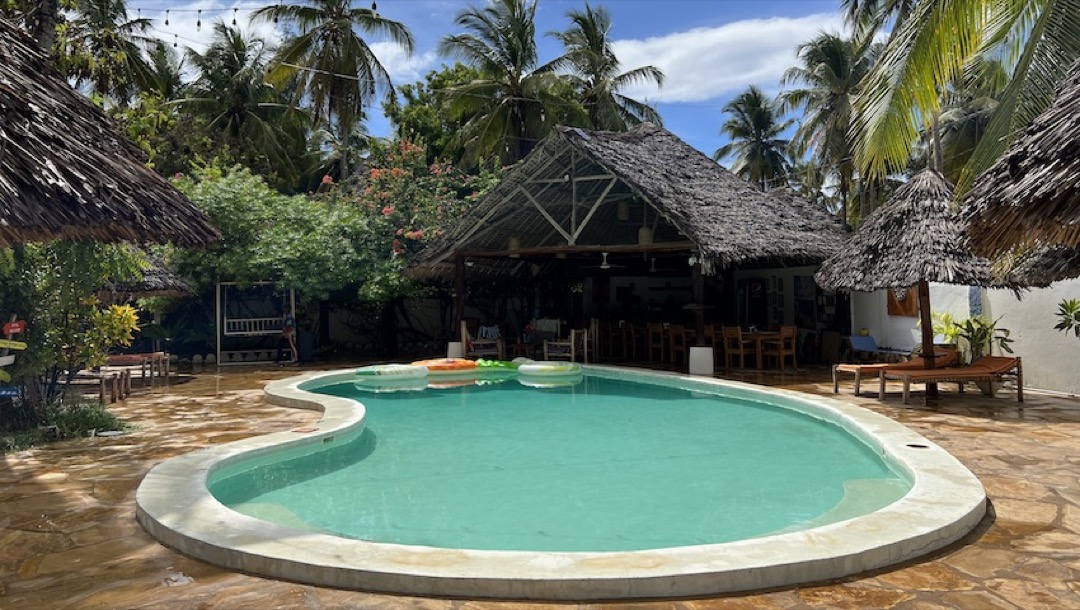
Zanzibar isn't incidental to this either. Distance is part of what makes a retreat work — real distance from your ordinary week, your phone, your routines, the version of you that everyone at home already knows. An island off the coast of East Africa gives you that distance without asking you to pretend it isn't happening.
For many participants, the trip itself — the flights, the different air, the unfamiliar road to the villa — becomes part of the preparation. By the time the ceremony begins, most people have already left their ordinary life behind, at least for a week. See how the rest of preparation works →
What happens once the ceremony itself begins is its own story — a long night, held in the Bwiti tradition, described in full elsewhere. See what a ceremony night is really like →
Romanian citizens don't need a visa to enter Tanzania for a stay like this — one less thing to arrange. Flights and travel insurance (roughly $44) aren't included in the retreat price, but airport transfers are, along with a translator for the group (English/French) and four assistants supporting the two lead facilitators throughout your stay.
The next edition runs 1–8 November 2026 — seven nights, groups capped at twelve people. See the full price and what's included →
The two people who lead the ceremony aren't newcomers to either side of this. Tembo (Nzambe Divanga) is a Franco-Gabonese hypnotherapist and musician, initiated in Gabon over 25 years ago and authorised to serve the sacred plant since 2015. Julie (Mudanga) was initiated in Gabon in 2007, in Mabundi, the female branch of the Bwiti Missoko Ngonde tradition, and is also a hypnotherapist and Bwiti healer.
Both live and work between Europe and Gabon. They bring the tradition to Zanzibar for each retreat — they don't bring the ceremony to Europe. See how the ceremony fits into the full therapeutic process →
Being held in Africa doesn't mean being held loosely. Every edition requires a health questionnaire, a recent ECG and cardiac screening, and an interview before booking — the same standard we'd expect anywhere this work is done responsibly. Iboga carries real cardiac risk, and certain medications and conditions can make it dangerous; any change to medication is made only with your own doctor.
Enrollment is by interview, not by payment. If iboga isn't right for your health or your timing, we'll say so. More questions answered →
Dates, price, what's included, who guides you and how to apply for an interview — all the details of the next edition are on the main page.
The 1–8 November 2026 retreat →